The Clockmaker's Study
A printable Halloween escape room for teens and adults.
It's eleven o'clock on Halloween night, and the door of Ambrose Vane's study has just clicked shut behind you. The clockmaker vanished from this room on Halloween in 1926, and he hid the way out in his own puzzles. Five puzzles feed one final lock, and you have until midnight.
- Ages
- Teens and adults (13+)
- Time
- 45–60 minutes
- Prep
- About 10 minutes of prep
- Pages
- 13 pages
- Players
- 3–8 players
- Difficulty
- Challenging
- Grown-up's role
- One host sets it up, then plays too
- Skills
- Codes · number locks · wordplay · picture rebuses · deduction · teamwork
- You'll need
- Scissors · tape · a pen · a timer · printer paper
Made for ages 13 and up
- Spooky level: The chill builds slowly, like a ghost story told late at night. Dim the lights and play a ticking clock somewhere in the house if your group wants more of it.
- Reading: Fluent reading in short pieces: the story card, a page of coded diary and six statement cards that can be passed around the table.
- Puzzles: Nothing needs outside knowledge. Every puzzle is solved from what's on the page, by deduction, careful counting and wordplay, and the group can split up and swap pages.
- Length: The story starts at eleven o'clock and the timer is set for 60 minutes, so the clock in the room and the clock in the story run out together.
What's inside
- A story card, and the Ledger, where the four answers come together.
- A knocking code tapped out under the floorboards.
- A number lock on an old apothecary cabinet.
- A diary written in shifted letters.
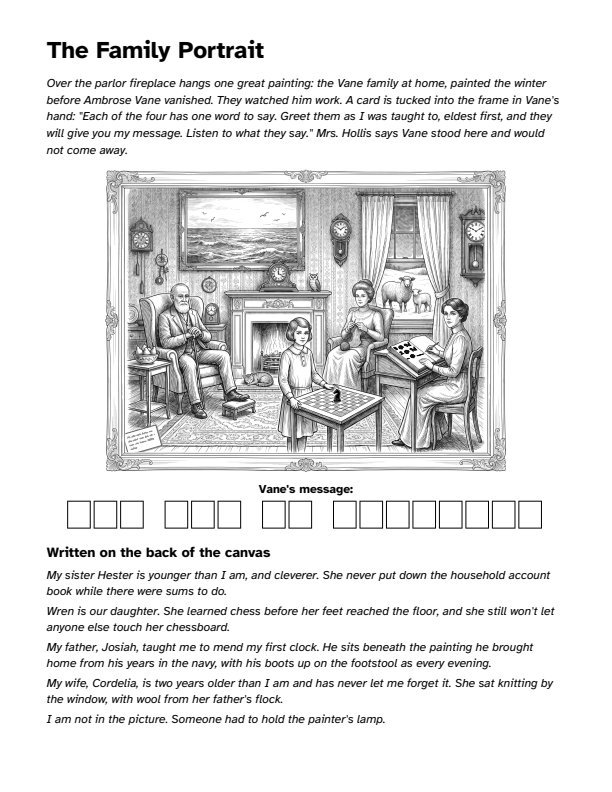
- Picture rebuses hidden in a painting of the family.
- A housekeeper's statement that ties the clues together.
- Fold-down hint strips and a sealed Answer Page.
Your part: Set the scene: lay the pages and hint strips where everyone can reach them, then join the search as one more player.
Download and print
Black and white, made for a home printer. Letter is the US and Canada size; A4 is used almost everywhere else.
How to run it
- Print the kit and allow about 10 minutes to set up.
- Cut the Housekeeper's Statement into its cards and shuffle them.
- Cut the hint strips apart, then fold and tape them, and tape the Answer Page shut.
- Spread the four puzzle pages around the room face down, and keep the Ledger with the statement cards for the end.
- Read the story card aloud and start a 60-minute timer.
- Solve the four pages in any order, writing each answer on its page, then bring them to the Ledger. When you know the final word, say it together and open the Answer Page.
In a classroom
Works for a teen party, a club or a classroom: one kit per group of 3 to 8. Plan about 10 minutes of setup and an hour to play.
For teachers and parents
Is it right for a teen party or a classroom?
Yes. It's eerie rather than gory, with no injuries or jump scares, and it works with 3 to 8 players. In a classroom, run one kit per group.
How hard is it?
It's a real escape room: five puzzles and a final lock in 45 to 60 minutes. First-timers usually need a hint or two, which is what the strips are for.
What does the host do?
About 10 minutes of setup: cut and fold the hint strips, tape the Answer Page shut and spread the pages around. After that, the host starts the timer and joins in.
How do hints work?
Each puzzle has a folded strip. Open one fold for the first hint and the next for the second; the last fold shows that puzzle's answer. There's no penalty.
Can the host play too?
Yes. Setup never asks you to read the answers, so the host solves alongside everyone else.
Questions
How many people can play?
Three to eight works best. With more, split into two teams with a kit each.
What if we run out of time?
Keep playing. The timer is for bragging rights, and the Answer Page is there when you're ready.
New printables on the way
We're working on more free kits. Tick the box and we'll email you when new ones are ready.
Play together in December
Kinundrum is testing a December puzzle countdown for families and friend groups, played together near or far. It's free for a limited number of groups.
Learn more