The Lantern Society
A spooky library mystery for 9- to 12-year-olds, inspired by The Legend of Sleepy Hollow.
Every Halloween, the Lantern Society of the Brindle Hollow library reads The Legend of Sleepy Hollow by lantern light. This year the lantern is missing, and the Keeper has left five puzzles behind.
Players build a cipher wheel, decode a message, put a torn story back in order, work through a logic grid and crack a number lock. A final riddle tells them where the lantern is hiding. Plenty of atmosphere, no gore, and the mystery has a real explanation.
- Ages
- Ages 9–12
- Time
- 45–60 minutes
- Prep
- About 5 minutes of prep
- Pages
- 14 pages
- Players
- 1–4 players, or a class in teams of 3–4
- Difficulty
- Medium
- Grown-up's role
- Optional: kids can run it themselves
- Skills
- Reading for detail · deductive logic · codes and ciphers · multiplication and place value · story sequence · multi-step directions · teamwork
- You'll need
- Pencils · scissors · glue stick · one paper fastener (brad, optional) · printer paper · card stock (optional) · timer (optional)
Made for ages 9–12
- Spooky level: The real fright is borrowed from the legend: the Headless Horseman chasing Ichabod home. The Society's own story stays cozy, with lantern-light readings and a hiding place to find.
- Reading: The retold legend fills a full page, and several puzzles test whether players took in its details, from names to the order of events.
- Hands-on: Cutting out two cipher wheels, five story cards and a membership card for each player, then gluing the story cards in order. The paper fastener is optional.
- Puzzles: The puzzles build on each other: the shelf lock needs a number from the logic grid, and the final riddle stays unreadable until all five letters are in.
What's inside
- The Keeper's letter and a clue tracker.
- The legend in brief, retold from Washington Irving's 1820 story.
- A two-part cipher wheel to cut out and turn, and a coded message to crack with it.
- A torn page to put back in story order.
- Who Sat Where?, a small logic grid.
- The shelf lock: library call numbers and multiplication.
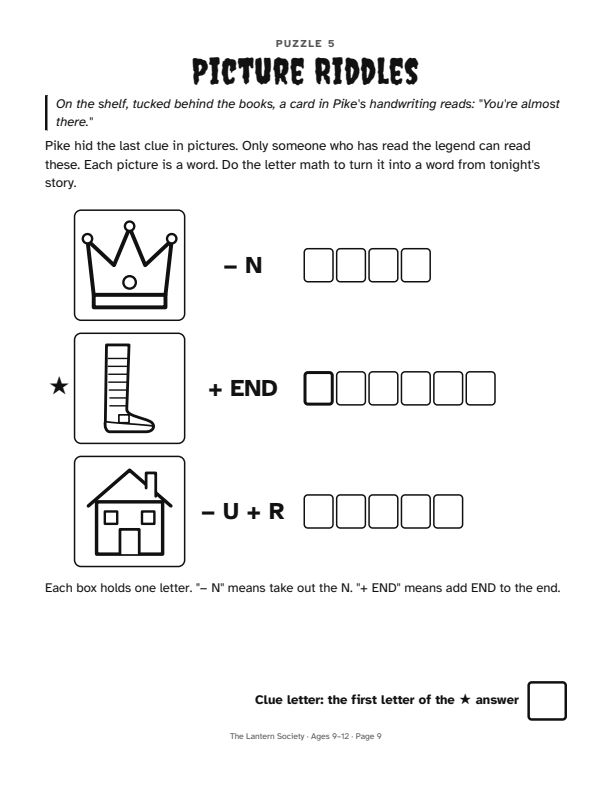
- Picture riddles, then a final riddle hidden behind a fold.
- Membership cards, a hints page and a sealed answer page.
Your part: Keep the taped-shut answer page with you rather than on the table, and stay within earshot for the final reveal.
Download and print
Black and white, made for a home printer. Letter is the US and Canada size; A4 is used almost everywhere else.
How to run it
- Print the kit. Fold the answer page in half, words inside, and tape it shut.
- Fold up the bottom of the last puzzle page along the dashed line so the ending stays hidden.
- Poke the center holes in the cipher wheels with a sharp pencil.
- Read the Keeper's letter and the legend aloud. Players need the legend for the puzzles.
- Each puzzle gives one clue letter for the tracker. Stuck? The hints page has two hints per puzzle.
- For a challenge, set a 45-minute timer. If time runs out, keep going.
In a classroom
Teams of 3–4, one kit per team. It fits a 50-minute period if you read the legend to the whole class first. Copy pages 4 and 6, the crafts, once per team.
For teachers and parents
Is it too scary for a 9-year-old?
It's spooky on purpose: a dark library, a legend, a missing lantern. Kids this age enjoy scares they know are safe, so there's atmosphere but no realistic harm, and the mystery ends with a real explanation.
Can kids run it without a grown-up?
Yes. The instructions are written for fluent readers, and the hints page lets players get unstuck on their own. A grown-up only needs to help with the prep: folding the answer page and poking the wheel holes.
How do I run it in one class period?
Read the legend to the whole class first, then hand each team of 3 or 4 a kit. Most teams finish within 50 minutes. Prepare the cipher wheels before class to save time.
Why is the answer page sealed?
From age 9 the letters arrive scrambled and only the final riddle puts them in order, so nobody can guess the ending halfway through. Taping the answer page shut keeps it that way.
What skills does it practice?
Reading for detail, deductive logic, codes and ciphers, multiplication and place value, story sequencing, following multi-step directions and teamwork. It makes no claim to match formal standards.
Questions
Is it okay to use The Legend of Sleepy Hollow?
Yes. Washington Irving published it in 1820, so it's in the public domain. The kit retells it in its own words.
Are there any small parts?
The one paper fastener (brad) is optional: it holds the cipher wheel together, but a fingertip works too. If you use it, keep it away from younger brothers and sisters.
New printables on the way
We're working on more free kits. Grown-ups can sign up for news about new printables on our home page. Sign up on the home page
Play together in December
Kinundrum is testing a December puzzle countdown for families and friend groups, played together near or far. It's free for a limited number of groups.
Learn more