The Harvest Supper
A seed library, a locked box and a supper waiting: a harvest puzzle hunt for 9- to 12-year-olds.
Every autumn the Fernbrook Seed Library holds a harvest supper, and everyone at the table takes home seeds from its big wooden box. This year the seed librarian has locked it with a word lock.
As the library's newest junior seed keepers, players scale a muffin recipe for thirty, work out where the beans go on a Three Sisters planting map, sort out who brought which dish, read a note written in seed-tray code and put the drawer labels back.
The letters come out scrambled, and only a coded riddle, read with all five, puts them in order. It works before any meal: a family dinner, a Friendsgiving or a class party.
- Ages
- Ages 9–12
- Time
- 60–90 minutes
- Prep
- About 5 minutes of prep
- Pages
- 13 pages
- Players
- 1–4 seed keepers at home, or a class split into teams of 3–4, one kit per team
- Difficulty
- Challenging
- Grown-up's role
- Optional: keeps the hint strips and passes one over on request
- Skills
- Multiplying fractions · scaling a recipe · logic puzzles · deductive logic · codes and ciphers · word patterns · reading a table · following multi-step directions · teamwork
- You'll need
- Pencils with erasers · printer paper · scissors (for the hint strips and cards) · tape · ruler (optional) · timer (optional) · a few real seeds in an envelope (optional)
Made for ages 9–12
- Reading: The story is told in short notes from the seed librarian, and each puzzle page says plainly what to find. Every puzzle can be read aloud by one player to the team.
- Hands-on: Players cut out and fold hint strips, unfold the ending and fill in Junior Seed Keeper cards. Nothing to build, and a ruler or strip of paper helps with the Seed Square.
- Puzzles: Five puzzles, each a different kind of thinking: fractions, a placement logic puzzle, a logic grid, a code and a word fit. The final riddle needs all five letters, so one wrong letter shows up at the end and sends players back to check.
- Length: At 60 to 90 minutes it fills the time before a big meal. In class, plan two periods.
What's inside
- Marisol Vega's welcome letter and a clue tracker.
- Muffins for Thirty: a recipe card to scale up with fractions and a measuring chart.
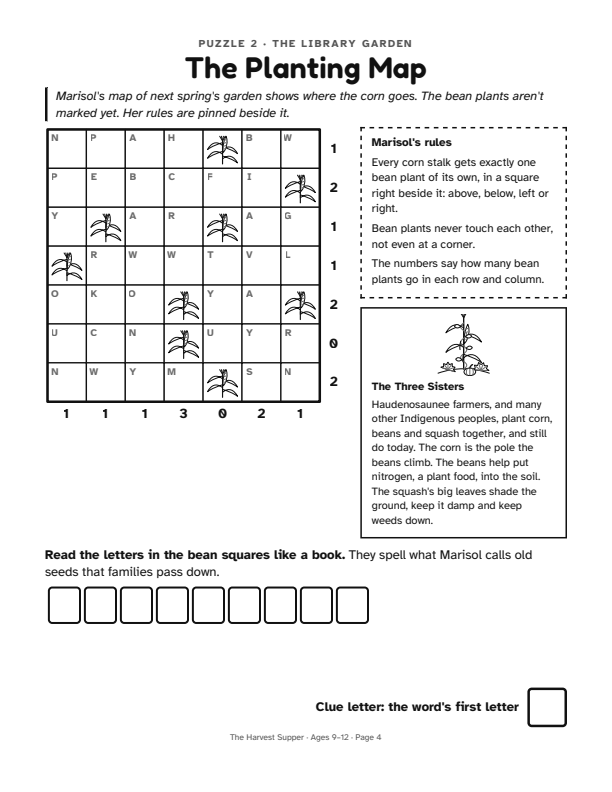
- The Planting Map: a Three Sisters garden where every corn stalk needs its own bean plant.
- Who Brought What?: a logic grid about four dishes and four thankful cards.
- The Seed Tray Code: a note in a tray-shaped code, with three letters nibbled off the key.
- The Seed Drawers: eleven seed labels to fit back into a grid of drawers.
- The Seed Square and a coded riddle that needs every clue letter to read.
- The ending behind a fold, Junior Seed Keeper cards, six hint strips and a sealed answer page.
Your part: Hold on to pages 11 and 12, pass a hint strip over only on request, and stay close for the moment the page 9 fold opens.
Download and print
Black and white, made for a home printer. Letter is the US and Canada size; A4 is used almost everywhere else.
How to run it
- Print every page at actual size on one side of the paper. Fold the answer page (page 12) in half, words inward, and tape the edges closed.
- Snip the six hint strips on page 11 apart and fan-fold each one so just its puzzle name is on top.
- Fold page 9's bottom section back on the dashed line and tape it down so the ending stays hidden.
- If you like, put a few real seeds in an envelope to hand over when the box opens.
- Players read Marisol's letter on page 2 aloud, then solve Puzzles 1 to 5. Any order works, but Puzzle 2 tells them something Puzzle 4 needs.
- Team stuck on a puzzle? Pass over its hint strip; they unfold the hints one by one.
- Want a challenge? Give the seed keepers 90 minutes on a timer. If it runs out, keep going: supper can wait a few minutes.
In a classroom
Give each team of 3–4 its own copy of pages 2–11, and keep the answer page at your desk. Over two class periods, do the recipe, the map and the logic grid first, then the code, the drawers and the lock. The Three Sisters facts on page 4 make a good start for a lesson on how Indigenous farmers plant.
For teachers and parents
What math does it use?
Puzzle 1 scales a recipe from 12 muffins to 30, so players multiply fractions and mixed numbers by 5/2 and match the results on a chart. The rest is logic, codes and word patterns.
How does it handle Thanksgiving history?
It doesn't retell a Thanksgiving origin story. It's set at a present-day seed library's harvest supper, and its one piece of history is real: the Three Sisters, corn, beans and squash, which Haudenosaunee and many other Indigenous farmers plant together today.
Can kids run it without a grown-up?
Yes, after the few minutes of prep. Each hint strip unfolds a step at a time, so seed keepers can get themselves unstuck and a grown-up just hands strips over.
How do I fit it into school time?
Use two periods: the recipe, the map and the logic grid in the first, the code, the drawers and the lock in the second. Copy the page 11 hint strips once per team, and keep the answer page with you.
What skills does it practice?
Multiplying fractions, scaling a recipe, logic puzzles, deductive logic, codes and ciphers, word patterns, reading a table, following multi-step directions and teamwork. It was written without reference to any formal standard.
Questions
Does it work for a Friendsgiving or a dinner that isn't Thanksgiving?
Yes. The story is a harvest supper at a seed library, so it fits any autumn meal: a family dinner, a Friendsgiving or a class party.
Do we need real seeds?
No. An envelope of real seeds to hand over at the end is a nice extra, but the kit works without one.
Is it hard?
It's meant to be a challenge for 9- to 12-year-olds. The pages don't walk players through each puzzle; the hint strips are there for when a team gets stuck.
New printables on the way
We're working on more free kits. Grown-ups can sign up for news about new printables on our home page. Sign up on the home page
Play together in December
Kinundrum is testing a December puzzle countdown for families and friend groups, played together near or far. It's free for a limited number of groups.
Learn more